

If you've typed your address into Zillow or Redfin recently, you already know that moment—the number appears, and suddenly you're either thrilled or second-guessing everything. I've had sellers call me excited about an online estimate that seemed high, and others who felt deflated before we even talked because the Zestimate came in lower than expected.
Here's what I tell them: that number is a starting point for curiosity, not a pricing strategy. Understanding how to price your Sacramento home correctly means looking beyond the algorithm to what's actually happening on your street, in your condition, with today's buyers. That process has a name—a Comparative Market Analysis, or CMA—and it works very differently than the tools you've been checking online.
Let me walk you through the difference, why it matters in Sacramento specifically, and how to read the real pricing signals before you list.
Why Online Home Value Estimates Miss the Mark
Automated Valuation Models (AVMs)—the technology behind Zillow's Zestimate, Redfin Estimate, and similar tools—use algorithms to estimate home values based on public records, tax assessments, and regional trends [1]. They process enormous amounts of data quickly, and for a free tool you can access in seconds, they're impressive. But they have blind spots that matter.
Zillow publishes its own accuracy metrics: a national median error rate of approximately 2.4% for on-market homes and around 7.5% for off-market properties [2]. Here's what that means in practice: Zillow's median error is 2.4%, but the range of error can stretch much wider—especially in neighborhoods with limited recent sales, older housing stock, or properties with non-standard features. In Sacramento, where the median home price hovers in the mid-$500,000s, even a 7% miss translates to $35,000–$40,000 or more.
The algorithm doesn't walk through your front door. It can't see what you've updated—or what you haven't.
Here's what AVMs typically miss:
Interior condition and updates. The algorithm doesn't know you remodeled your kitchen last year or that your neighbor's home still has original 1985 finishes. Both might show similar square footage, but they're not the same product.
Lot-specific factors. Backing to a greenbelt versus a busy arterial road? AVMs often treat both the same because the lot size matches on paper.
Concessions and terms. A home that sold for $550,000 with $15,000 in seller-paid closing costs isn't really a $550,000 comp—it's a $535,000 effective price.
Hyperlocal micro-markets. Sacramento neighborhoods shift block by block. Land Park's historic tree-lined streets and 1930s bungalows attract a different buyer (and different pricing dynamics) than Pocket's 1970s–1980s tract homes near the river. Tahoe Park, Midtown, Natomas, Elk Grove—each behaves differently, even when zip codes overlap.
Online estimates are useful for satisfying curiosity. They're not useful for setting your list price.
What a Comparative Market Analysis Actually Shows You
A Comparative Market Analysis is the method real estate professionals use to determine a realistic price range for your home. Unlike an AVM, a CMA involves a licensed agent manually reviewing recent sales, pending transactions, and active competition—then adjusting for the specific differences between those properties and yours [3].
Think of it as investigative work. The goal isn't to find identical homes (they rarely exist). The goal is to find the most comparable homes and then account for what makes yours different—better or worse.
A strong CMA examines:
Sold properties (what buyers actually paid—the clearest signal)
Pending sales (what buyers are willing to pay right now, before closing)
Active listings (your direct competition when you go live)
Expired or withdrawn listings (homes that overpriced and failed—important context)
It also incorporates market metrics that reveal current buyer behavior. Days on market tells you how long homes are taking to sell. List-to-sale ratio shows how close final sale prices land to original asking prices. In a balanced Sacramento market, a list-to-sale ratio near 100% signals accurate pricing across the board. A ratio consistently below 98% may indicate softening demand—or a pattern of sellers pricing too high and adjusting down [4].
A CMA isn't a guarantee of what your home will sell for. It's a framework for understanding where you fit in today's market and how to position accordingly.

The 5 Comp Filters That Drive Accurate Pricing
Not every recent sale qualifies as a meaningful comp. Agents apply a filtering process to narrow the field to the homes most likely to reflect your home's actual market position. Here are the five filters that matter most:
1. Time
Markets shift. A home that sold eight months ago closed under different interest rate conditions, different inventory levels, and different buyer psychology than one that sold last month. The most reliable comps are typically within the past 90 days. In a fast-moving Sacramento market, even 60-day-old data can start to drift from current reality [5].
2. Distance
Proximity matters more than most sellers realize. A comp three blocks away in the same subdivision carries far more weight than one a mile away in a different neighborhood—even if the square footage matches perfectly. Appraisers and agents typically prioritize homes within a half-mile radius when possible. In dense urban pockets like Midtown or East Sacramento, that radius tightens further because micro-neighborhoods have distinct identities and price floors [5].
3. Condition
This is where AVMs fall apart completely. A 2,000-square-foot home with dated carpet, popcorn ceilings, and deferred maintenance isn't comparable to a 2,000-square-foot home with new flooring, modern fixtures, and a refreshed exterior—even if they're on the same street. Agents adjust for condition based on visual inspection, listing photos, and market feedback. This adjustment requires local judgment, not just formulas.
4. Upgrades and Features
Specific improvements carry different weight depending on what buyers in your price range expect. In Sacramento, energy-efficient HVAC systems, solar panels (owned, not leased), updated kitchens, and ADU potential tend to move the needle. A pool might add value in Elk Grove where larger lots and family buyers dominate—or subtract value in Midtown, where smaller lots and low-maintenance preferences are more common.
5. Concessions and Sale Terms
The sale price on paper doesn't always tell the full story. If a seller paid $20,000 toward the buyer's closing costs, that home effectively sold for $20,000 less than the recorded price. If the seller included appliances, furniture, or repairs, those have value too. A good CMA adjusts for these concessions to reveal what buyers were truly willing to pay out of pocket [6].
When you see an agent dismiss a "comparable" sale because the terms were unusual, this is what they're protecting you from: bad data leading to bad pricing.
How Sacramento's Market Context Shapes Your Strategy
Pricing strategy doesn't exist in a vacuum. Sacramento's market dynamics—inventory levels, interest rate environment, and buyer demand—affect how aggressively or conservatively you should price.
When days on market averages are low (under 15–20 days) and list-to-sale ratios are at or above 100%, competition is strong. In this environment, pricing at market value—or even slightly below—can generate multiple offers and drive the final sale price above asking. Strategic underpricing isn't about leaving money on the table; it's about creating urgency that attracts more buyers and better terms.
When inventory rises and days on market stretch past 30 days, overpricing carries real risk. Homes that sit tend to attract lowball offers, require price reductions, and generate buyer skepticism ("What's wrong with it?"). The first two weeks on market generate the most attention from active buyers. Missing that window is difficult to recover from—you're no longer the shiny new listing; you're the one that's "been sitting" [7].
Your CMA should reflect current absorption rates and competitive positioning, not just backward-looking sales data. The best pricing decisions are forward-looking: Where is the market heading over the next 30–60 days, and how do you position to meet it?
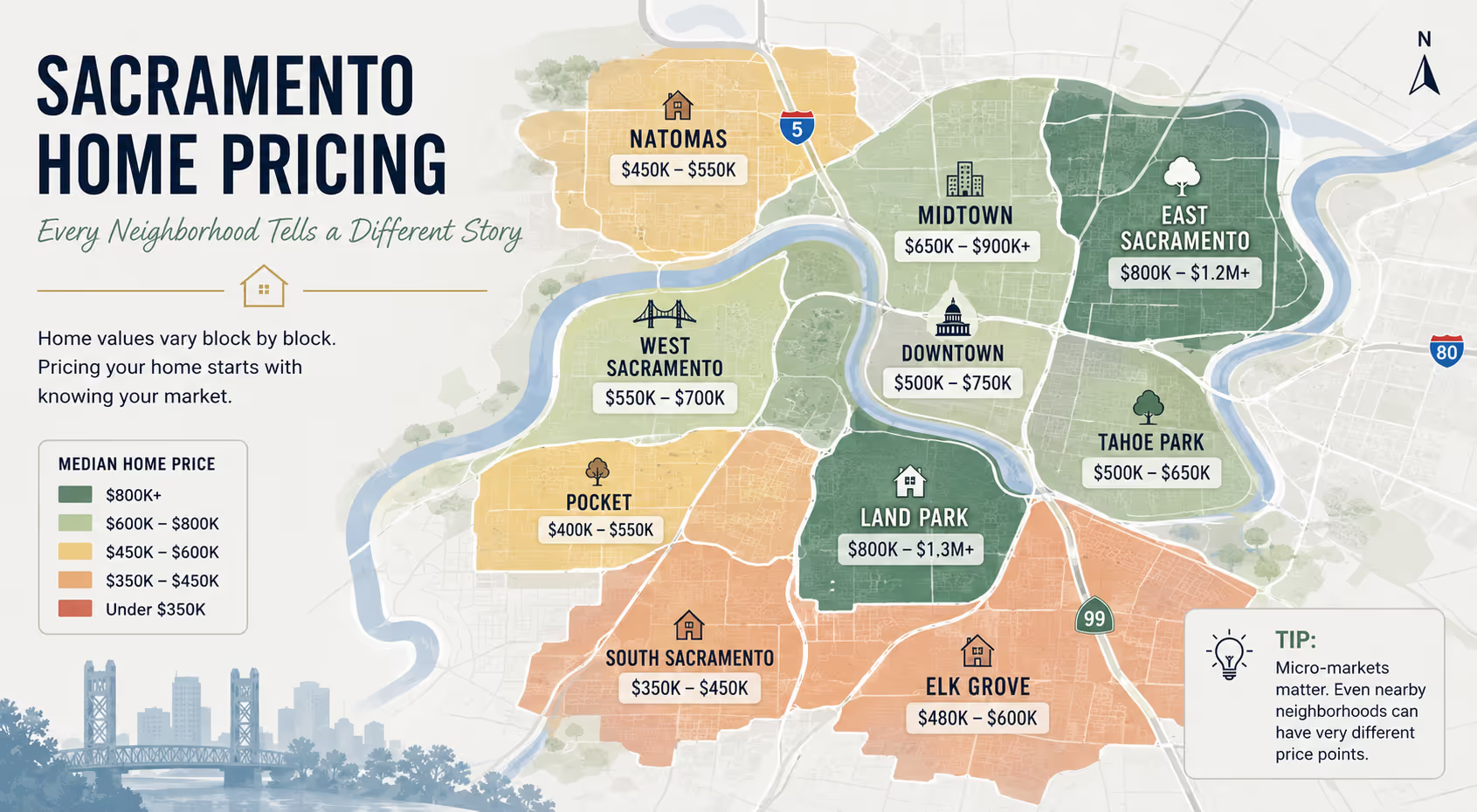
When to Trust Each Tool
| Tool | Best Use | Limitations |
| Online Estimate (AVM) | Rough ballpark; tracking general trends over time; satisfying curiosity | Ignores condition, upgrades, concessions, hyperlocal factors; can be off by tens of thousands |
| Comparative Market Analysis | Setting a realistic list price range; understanding competitive positioning; developing pricing strategy | Requires agent expertise; still involves professional judgment; not a guarantee |
| Appraisal | Lender requirement; establishes value for financing purposes | Backward-looking; typically completed after an accepted offer; appraiser may not know your upgrades |
Online estimates answer the question: What might my home be worth in a general sense?
A CMA answers the question: What will buyers actually pay for my home, given what else they can choose from, in today's Sacramento market?
If you've seen a low online estimate and worry it will affect how buyers perceive your home, understand this: buyers don't make offers based on Zestimates. They make offers based on what else is available at that price point and how your home compares. A well-priced home with strong presentation will outperform its algorithm estimate. A poorly positioned listing will underperform—regardless of what Zillow says.
Pricing Strategy Is a Lever—Not a Guess
The right price isn't a single magic number. It's a range, informed by data, shaped by your timeline and goals, and adjusted for how you want to position against the competition.
Price too high and you risk sitting on market, accumulating days on market, and eventually reducing—often to below where you could have started. Every price reduction signals to buyers that you were wrong the first time, which weakens your negotiating position.
Price too low and you may leave equity behind—though in competitive conditions, strategic underpricing can generate a bidding war that lifts the final price above asking. This approach requires the right market timing and a tolerance for some uncertainty, but it's a legitimate strategy when conditions support it.
Price accurately and you attract the buyers who are actually shopping in your range, generate showings quickly, and create the conditions for a strong offer within the first two weeks.
A well-prepared CMA gives you the information to choose your strategy intentionally—not react emotionally to an algorithm's guess.
Get a Free Sacramento CMA Before You List
If you're thinking about selling your Sacramento home, start with real data—not an algorithm's estimate.
I offer a no-pressure CMA that walks you through recent comps, current competition, and what your home's realistic price range looks like given today's market conditions. No inflated promises. No "you'll definitely get X." Just the information you need to make a confident decision about timing, pricing, and preparation.
Request a free Sacramento CMA to get a pricing range for your home.
Frequently Asked Questions
How accurate are Zillow and Redfin home value estimates?
Zillow reports a median error rate of approximately 2.4% for on-market homes and around 7.5% for off-market properties [2]. Redfin publishes similar figures. In practical terms, this means estimates can be off by tens of thousands of dollars—especially for homes with unique features, recent upgrades, limited comparable sales in the area, or in neighborhoods where properties vary widely. The median error is the middle of the range; your specific home could fall well outside it.
What is a Comparative Market Analysis (CMA)?
A CMA is a report prepared by a real estate agent that analyzes recent sales, pending transactions, and active listings to estimate a home's current market value [3]. Unlike automated estimates, a CMA accounts for property condition, upgrades, lot factors, concessions, and hyperlocal dynamics through professional evaluation. It's the foundation for setting a strategic list price.
How do agents adjust comps for differences between properties?
Agents apply adjustments based on factors like square footage, lot size, condition, upgrades, views, and sale terms. For example, if a comparable home sold with $15,000 in seller-paid closing costs, the effective sale price is adjusted downward to reflect what the buyer actually paid out of pocket [6]. If your home has a newer roof and the comp had deferred maintenance, that's factored in as well. These adjustments require local market knowledge and professional judgment.
What does list-to-sale ratio tell me about pricing?
List-to-sale ratio measures how close homes sell to their original asking price. A ratio near 100% suggests homes are priced accurately and selling at or near asking. Ratios consistently below 98% may indicate overpricing patterns or softening demand in that price segment [4]. Tracking this metric helps you understand whether the market is rewarding accurate pricing or punishing optimistic sellers.
How recent should comps be to trust them?
Most agents and appraisers prefer comps from the past 90 days, with 60-day-old data being ideal in active markets [5]. Older sales may reflect different interest rate conditions, inventory levels, or seasonal demand—making them less reliable for current pricing decisions. In a market that's shifting (either direction), recency matters more than volume.
About This Content
This article was prepared to help Sacramento-area homeowners understand the pricing process before listing. The information reflects standard real estate practices, publicly available market data, and guidance consistent with California Department of Real Estate advertising standards. Tavon Willis is a California-licensed real estate salesperson (DRE #02095751) serving Sacramento, Elk Grove, and surrounding communities.
Cited Works
[1] Consumer Financial Protection Bureau — "What is an Automated Valuation Model (AVM)?" https://www.consumerfinance.gov/ask-cfpb/what-is-an-automated-valuation-model-avm-en-1865/
[2] Zillow — "How Accurate is the Zestimate?" https://www.zillow.com/z/zestimate/
[3] National Association of REALTORS® — "Field Guide to CMAs." https://www.nar.realtor/field-guides/field-guide-to-cmas
[4] California Association of REALTORS® — "Housing Market Statistics." https://www.car.org/marketdata/data/housingdata
[5] Fannie Mae — "Selling Guide: Comparable Sales." https://selling-guide.fanniemae.com/sel/b4-1.3-09/comparable-sales
[6] Appraisal Institute — "The Appraisal of Real Estate, 15th Edition" (guidance on concession adjustments). https://www.appraisalinstitute.org/the-appraisal-of-real-estate-15th-edition/
[7] National Association of REALTORS® — "Home Buyer and Seller Generational Trends Report." https://www.nar.realtor/research-and-statistics/research-reports/home-buyer-and-seller-generational-trends


